
 (602) 919-5915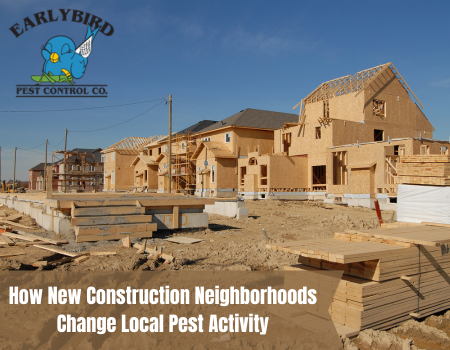
New construction neighborhoods in Arizona don’t create pests, they relocate them. The desert terrain that gets graded, cleared, and built on was already supporting established populations of scorpions, rodents, rattlesnakes, and the insects they hunt. Development doesn’t eliminate those populations — it displaces them into the surrounding areas and into the structures being built, creating pest pressure patterns that established neighborhoods don’t experience at the same intensity and that new homeowners moving in from other markets aren’t prepared for.
Understanding what new construction does to local pest activity changes what the first few years of pest management in a new development actually require.
Pests Adjust to New Construction Neighborhoods
Displacement and the Pressure Spike
The grading and clearing that precedes construction is the most significant single pest event that a new development creates. Every scorpion, rodent, and snake that was living in the desert terrain being cleared has to go somewhere. Some die. Most relocate to adjacent areas — the lots that haven’t been built on yet, the desert preserve that borders the development, the retention basins and undeveloped common areas that exist in every new Arizona subdivision. The structures being built at the edges of those areas receive the displaced population’s pressure immediately.
The pressure spike that new homeowners experience in the first year or two of a new development isn’t bad luck. It’s physics. The population that was distributed across the original habitat has been compressed into a smaller area, the food and shelter resources that supported it have been disturbed, and the new structures represent the most stable shelter in a landscape that’s been disrupted. A bark scorpion that was living under a rock in the desert a year ago is now living in the block wall of a backyard because the rock is gone.
This pressure typically peaks during the active construction phase and the first year or two after homes are occupied, then gradually normalizes as the population redistributes, the landscaping matures, and the development reaches an equilibrium with the surrounding desert. Homeowners who expect the pest activity of an established neighborhood when they move into a new development set themselves up for the frustration of a comparison that doesn’t hold for the first several years.
What New Construction Itself Attracts
The new construction process creates pest attractants that are distinct from the displacement effect and that persist through the building phase. Construction debris — lumber scraps, cardboard, pallets, waste material — creates harborage for rodents, scorpions, and roaches that concentrates them on and around the building site. Water from concrete work, irrigation testing, and other construction activities creates moisture in desert terrain where moisture is otherwise scarce, and moisture in the desert attracts everything that needs it.
The structures themselves during construction are accessible in ways that occupied homes aren’t. Open wall cavities before drywall, unsealed penetrations, gaps at foundation transitions that haven’t been addressed yet — these are entry points that pests establish paths through before occupancy rather than finding after it. A home that’s been occupied and then pest-treated has a different baseline than a home where pests were never excluded from the structure during construction, and the homeowner moving in often doesn’t know which situation they’re inheriting.
Electrical conduit runs, plumbing penetrations, and HVAC rough-in create pathways through the structure that are sometimes sealed incompletely at construction completion. In established neighborhoods these penetrations have been there for decades and the sealing around them — however imperfect — has been supplemented by caulk, paint, and general settling. In new construction the sealing is as-built and the quality varies enough that inspection of every penetration point is a legitimate first-year maintenance step rather than an unusual precaution.
The Landscaping Transition for New Construction Homes
New construction neighborhoods go through a landscaping transition that creates its own pest pressure pattern. Freshly installed landscaping — new plants, bark ground cover, irrigation systems establishing themselves — creates conditions that differ significantly from both the bare dirt of active construction and the mature desert landscaping of an established neighborhood.
Bark mulch installed against foundations creates scorpion harborage directly adjacent to the structure’s entry points. Dense new plantings touching exterior walls create pathways and shelter that established landscape management eliminates over time. Irrigation systems that are overwatering during the establishment phase create moisture conditions at the foundation that attract the insects scorpions hunt and create conditions favorable to cockroaches and other moisture-dependent pests.
The landscaping that matures into a well-managed desert palette with appropriate spacing, minimal bark against the structure, and irrigation calibrated to plant needs rather than establishment watering creates a very different pest environment than the newly installed version of the same yard. The pest pressure that came with the landscaping installation doesn’t necessarily represent what the property will be like once the landscaping matures and management practices normalize.
What New Homeowners Should Do Differently in New Construction Homes
The pest management approach that works in an established neighborhood isn’t adequate for the first few years in a new construction community. The displacement pressure, the construction-era entry points, and the landscaping transition create conditions that require more proactive management than a reactive treatment-when-something-appears approach provides.
Exclusion work done at move-in rather than after the first scorpion encounter is more effective and less expensive than the reactive version. Inspecting and sealing every penetration, installing appropriate door sweeps, and addressing the entry points that new construction created before they’ve been used produces a different pest history for the home than waiting until the first season of encounters establishes which entry points are active.
Understanding that the first two years in a new Arizona development represent a specific phase of pest activity that normalizes over time is the expectation management that prevents the frustration of comparing the experience to what the same investment level produces in an established neighborhood. The new development isn’t a permanent pest problem. It’s a temporary disruption that requires temporary adjustment.
The University of Arizona Cooperative Extension’s pest management resources cover how desert habitat disruption affects pest population distribution, what displacement patterns follow new construction and grading activity in Arizona desert terrain, and what integrated pest management approaches address the specific pressure patterns that new development creates — scientific authority that goes deeper than general pest control advice and that’s specific to Arizona’s desert pest species and habitat.
Recent Comments