
 (602) 919-5915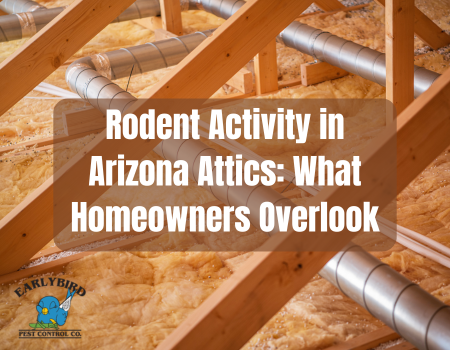
Most homeowners in the West Valley find out they have a rodent problem in the attic the same way — something sounds wrong at night. Scratching, movement, the particular sound of something running along a joist at 2am. By the time that’s happening, the problem is already weeks or months old. Rodents don’t announce themselves early. They get established quietly, and the attic is the perfect place for it because nobody goes up there. Not really. Not until something forces the issue.
Arizona makes this worse in a specific way. The same heat that drives people indoors drives rodents up. Roof rats and pack rats both move vertically when ground temperatures get extreme, and an attic that’s 140 degrees in July is still more survivable than asphalt at 160. They’re not comfortable up there. They’re just making tradeoffs, the same as anything else trying to get through an Arizona summer.
Insulation Damage
This is the part that costs the most and gets discovered last. Rodents don’t damage insulation incidentally — they use it. They tunnel through it, nest in it, compress it, saturate it. Blown-in insulation that was doing its job at an R-38 rating can lose a third of its effective value from a moderate infestation without looking obviously destroyed from the access hatch. You’d have to get in there and actually move through the space to see the full picture, and most people don’t do that.
The contamination issue is separate from the performance issue and in some ways worse. Rodent urine soaks into insulation and stays there. It doesn’t dry out and disappear in the heat — it concentrates. A space that’s been active for a full season has damage that isn’t remediated by trapping the animals and calling it done. The insulation comes out. All of it, usually. That’s a significant project that runs into the thousands of dollars and could have been caught much earlier if anyone had been paying attention to what the attic actually looked like.
Wiring Hazards
Rodents chew wiring because their teeth grow continuously and they need to wear them down. There’s no other reason. It isn’t about the wire specifically — it’s about the texture and resistance. Unfortunately PVC wire insulation is exactly the right resistance, and an attic full of it is essentially a chew toy. What they leave behind is exposed conductor sitting in a space full of blown insulation and wood framing, and that combination has a specific outcome that doesn’t require much imagination.
The frustrating part is that chewed wiring in an attic doesn’t always cause an immediate failure. It can sit there, exposed, for months before it arcs against something or gets wet enough to short. Homeowners in Peoria and Buckeye have had electrical fires traced back to rodent damage that happened well before any visible signs of an infestation showed up elsewhere in the house. An electrician going through an attic after a confirmed rodent problem will sometimes find damage in four or five separate locations. Each one is a potential ignition point that was just waiting for the right conditions.
Prevention
The entry points that matter most are the ones at roofline level — gaps where the fascia meets the soffit, openings around roof vents that have never had hardware cloth installed behind them, spots where stucco pulls away from the roofline and leaves a gap that looks minor from the ground but is plenty large from the perspective of a roof rat. These aren’t dramatic openings. A roof rat needs about the size of a quarter. A pack rat needs a little more but not much.
Exclusion has to be physical. Repellents, ultrasonic devices, mothballs in the attic — none of it holds up against an animal that’s motivated and has found a reliable entry point. Steel wool packing followed by caulk or expanding foam, hardware cloth over any vent opening larger than a quarter inch, a proper inspection of the roofline that actually involves getting on the roof and looking rather than squinting from the driveway. The prevention side of this is genuinely not complicated. What makes it complicated is that most homeowners don’t think about the attic until something is already living in it, and by then prevention is no longer the conversation.
Recent Comments