
 (602) 919-5915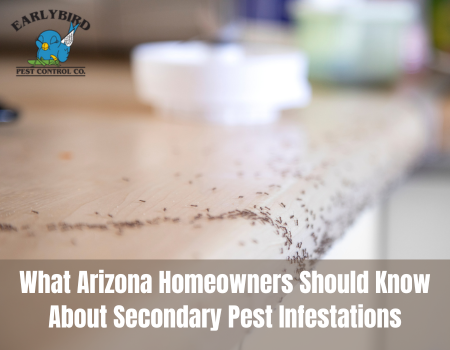
When Arizona homeowners notice pests, the focus is usually on the most visible or alarming one, for instance a scorpion in the bathroom, ants in the kitchen, or a mouse in the garage quickly becomes the main concern. What many people do not realize is that pests rarely appear alone. In Arizona, one infestation often triggers another. These are known as secondary pest infestations, and they happen more often than most homeowners expect.
What Are Secondary Pest Infestations
A secondary pest infestation occurs when one pest creates conditions that attract another, and this is common in Arizona because many pests exist within the same food chain or rely on similar shelter and water sources.
For example, eliminating one pest without addressing the environment that supported it can leave behind food sources, moisture, or shelter that draws in a different species. Homeowners may feel like a new infestation appeared out of nowhere, when in reality it was encouraged by the first problem.
Why Ants Often Appear After Scorpions
Scorpions are one of the most feared pests in Arizona, but they rarely arrive on their own. Scorpions feed on insects, especially ants, crickets, and cockroaches, so when a home has an ant problem, scorpions often follow.
In some cases, homeowners treat for scorpions without addressing the insects they prey on. When scorpions are removed, the underlying ant population remains and may even increase due to reduced predation, and that will lead to more visible ant activity indoors.
The reverse also happens, when ants are disturbed through landscaping or treatment, scorpions may move deeper into the home in search of food. Treating one pest without understanding its role in the ecosystem can unintentionally shift the balance rather than solve the problem.
Rodents Can Attract Snakes
Rodents are another primary pest that often leads to secondary infestations. Rats and mice are attracted to attics, sheds, and garages for food and shelter. Once rodents establish themselves, they attract predators.
In Arizona, snakes frequently follow rodent populations. Yards with active rodents become hunting grounds. Snakes may enter properties through block walls, crawl spaces, or gaps under doors while tracking their food source.
Homeowners who focus only on removing snakes may see repeat sightings if rodents are still present, so until the rodent population is controlled, snakes are likely to return.
How One Problem Becomes Many
Secondary infestations are fueled by three main factors: food, water, and shelter. When one pest establishes itself, it often increases at least one of these elements.
Ants leave scent trails and access points that other insects use, rodents create nesting materials and droppings that attract insects, insects attract predators, and moisture problems that support cockroaches may also support termites or ants.
These chain reactions explain why homes sometimes experience a sudden surge of different pests within a short period of time. The environment has become favorable, and multiple species take advantage of it.
Why Arizona Homes Are Especially Vulnerable
Arizona’s climate plays a major role in secondary infestations. Extreme heat drives pests indoors in search of cooler temperatures and water. Landscaping, irrigation, and construction can also disturb pest habitats, pushing them toward homes.
Block walls, desert vegetation, and gravel yards provide excellent shelter for insects and rodents. Once pests move close to the home, small gaps around doors, plumbing, and foundations become entry points, and because many Arizona pests are nocturnal or seasonal, homeowners may not realize a chain reaction is already in motion until multiple pests become visible.
Preventing Secondary Pest Infestations
The most effective way to prevent secondary infestations is to address pest problems holistically, this means looking beyond the pest you can see and identifying what attracted it in the first place.
Reducing food sources is critical, and it involves keeping food properly sealed inside the home, managing trash carefully, and reducing insect populations that draw in predators. Moisture control is equally important, and it involves fixing leaks, adjusting irrigation, and improving drainage remove a major attraction for many pests.
Sealing entry points helps stop multiple pests at once. Cracks, gaps, and worn seals allow insects, rodents, and reptiles access to the home, and so regular exterior inspections make a big difference.
When Professional Insight Matters
Secondary infestations can be difficult to identify without experience. Professional pest inspections often reveal connections homeowners miss. Treating pests in isolation may provide temporary relief, but addressing the main attraction prevents repeat problems.
Understanding the Bigger Picture
In Arizona, pests are part of a larger ecosystem. When one pest appears, it is often a sign of another nearby. Ants after scorpions, snakes after rodents, and insects following moisture issues are all examples of how quickly problems can multiply.
When you understand secondary pest infestations and address the root causes, you can protect your home more effectively and avoid the frustration of recurring pest issues that seem to come from nowhere.
Recent Comments